
By the Delaney Agency Editorial Team. Based on the 10.19.2026 – wake up call ft ceo brian delaney with drew mcclure. Content type: Leadership Perspective.
Key Takeaway:
When a new insurance agent stalls, the cause is usually a skill gap or a belief gap. On a recent Monday Wake-Up Call at the Delaney Agency, co-operator Drew McClure shared four questions, drawn from Byron Katie’s method, The Work (from her book Loving What Is), for finding the hidden thought behind call reluctance. His point: most growth comes from letting a belief go, not adding a new one.
Before a single sale gets made on a Monday, there’s a quieter question sitting in a lot of agents’ heads. Am I bothering this person? On the Monday Wake-Up Call recorded on October 19, 2026, Drew McClure, a performance coach, podcast host, author and keynote speaker who co-led the call, told the story of a medical device sales rep who carried that exact feeling into every appointment. He had the training and he knew his product. What he didn’t have was permission, from himself, to walk in like he belonged there.
This article covers what Drew and the Delaney Agency CEO Brian Delaney walked agents through on that call: how to tell whether you’re stuck on skills or on belief, the four questions Drew uses to pull a limiting thought apart, a simple exercise for stepping out of it, and why Brian believes the work is worth showing up for without hesitation. If you’re new to selling life insurance and you’ve felt call reluctance, this one is for you.
What is call reluctance?
Call reluctance is the hesitation that stops you from picking up the phone or starting a sales conversation, even when you know how to do it. It shows up as finding other tasks before your dials, over-preparing, rushing through calls, or apologising for taking someone’s time. Sometimes it’s a skill gap you can train. Often, the skill is already there and a thought underneath is slowing you down.
Key moments: Skill vs mindset (13:21) · Drew’s sales rep story (14:13) · The four questions (17:01) · The alternate universe exercise (29:40) · Brian’s Craigslist story (33:12) · Why the work matters (35:43)
Is call reluctance a skillset problem or a mindset problem?
Drew McClure opened his segment with a diagnostic question every agent can run on themselves. “We have to decide and investigate when we’re stuck at a ceiling,” he said. “Is it a skillset issue or is it a mindset and belief issue?” In his experience, it’s one or the other nine times out of ten.
Sometimes it really is skill. Earlier in the same call, Brian worked through one live with agent Rebecca Fontenot, who has been partnering with fellow agent Cindy Dunham to tighten each part of their appointments. Rebecca had written a sticky note: “I write an application in every appointment I sit.” Her new approach, in her words, is “not asking for permission after they’ve already shared with me that it’s a need and not a luxury.” When a family isn’t sure which option or price fits, she starts with guaranteed accidental coverage “in case something unforeseen happens” and works out the rest from there. Brian summed up the idea as “finding a place to start and not a place to finish.”
Disclaimer: Rebecca’s sticky note is her own goal, not a typical result. Individual results vary and depend on effort, skill, consistency, market conditions, and other factors.
That’s a skill fix. A different sentence, a different sequence, and results change. Our recap of the Help Desk Call goes deeper on that side. But Drew was clear that other times “the skillset is there and it’s not holding us back, but a mindset is.” His advice for working out which one you’re dealing with is plain: go to a leader and say, “Hey, I need you to look through my numbers.” If the numbers show a skill gap, you train it. If they don’t, your call reluctance may be coming from a belief, so keep reading.
Still weighing the career itself? Read why becoming an insurance agent remains a strong choice in 2026, and the steps to get started.
The internal governor: a story from a volcano at 2:00 a.m.
Drew’s story started on a vacation in Hawaii, roughly seven or eight years ago, on a 2 a.m. bus to watch the sunrise from Haleakalā. At a bathroom stop, everyone got off except Drew and one other man. Drew struck up a conversation. The man turned out to be from Greenville, South Carolina, and Drew had gone to school at Clemson. The two couples ended up having dinner together every night of the trip.
The man worked in medical device sales for a large company. When Drew mentioned his podcast, he undersold it, figuring the man would never listen. About three months later the man called to say one episode had changed his sales.
The episode was about a single question: who would I be without that thought? According to Drew, the man was listening on his way to meet a doctor and sat in the hospital parking lot, five minutes late, because he didn’t want to get out of the car until it finished. In that moment he named the thought behind his anxiety. “I feel like I’m an inconvenience,” he realized. He believed he was pushing himself onto busy doctors’ calendars, so he rushed, and he almost apologized for taking up their time.
Then he asked what he actually believed. The answer was simple: “I actually believe in this product.” So he decided to walk into that appointment as someone with something worth the doctor’s time. Drew says “it was the first time he walked in free.” Drew also says the man has since been one of his company’s top salespeople in the country and now oversees its Southeast region.
Drew compared that hidden belief to the governor on a golf cart. The cart is capable of more, but something built in keeps it slow. “He had the skillset,” Drew said, “but when it was ready to go… something was slowing him down.” For this rep, the governor was the belief that he was a burden. Drew’s point is that people pick up on that energy. When the rep walked in feeling like a burden, the doctors treated him like one. When he walked in excited, they leaned in.
Drew drew a line between being excited after you close a sale and being excited before you get the chance to sell. If you wait for the sale to feel good, he said, “that means you’re delaying optimism.”
How do you question a thought that’s holding you back?
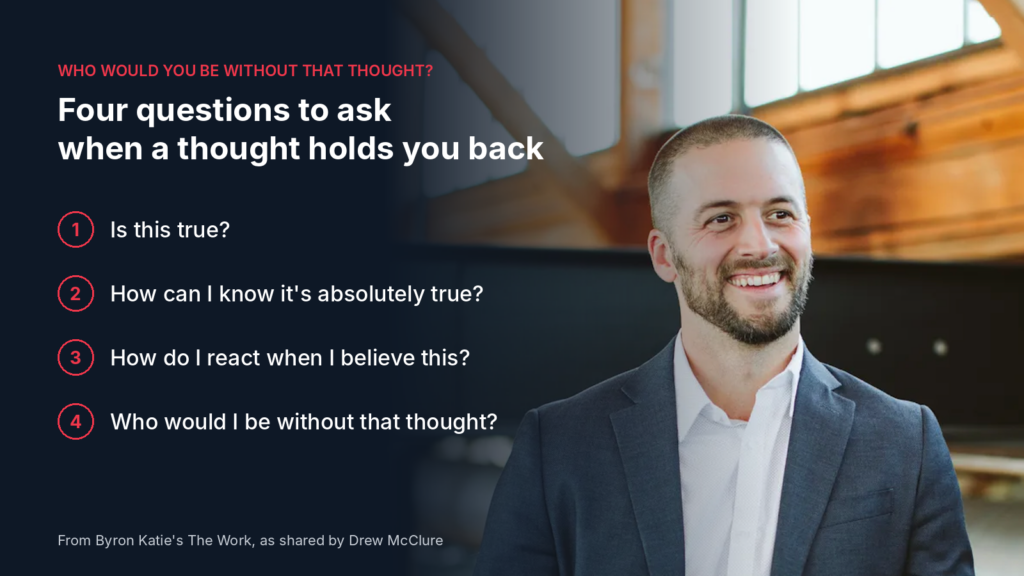
The tool Drew used comes from Byron Katie’s method, The Work (from her book Loving What Is), which he described as built on decades of her work with clients whose suffering came from over-identifying with certain beliefs. Drew walked agents through it as four questions you ask when the thought shows up:
1. Is this true? Most of us will say yes at first, because we’re already buying into it.
2. How can I know it’s absolutely true? Not “does it feel true,” but is there any evidence against it?
3. How do I react and behave when I believe this? This is where you start to see what the thought is costing you.
4. Who would I be without that thought?
In Katie’s method, the next step is to turn the thought around and find where the opposite is just as true.
Drew then added an exercise of his own, which he described using with a CEO of a large real estate development company. She privately believed she was stupid, a belief she said she’d held since childhood, and it made her guarded in meetings. Drew asked her to imagine an alternate universe where everything about her life was identical, same parents, same failures, same successes, except that the thought never occurred to her. Not a thought she beat. One she never had.
What would be different on its own? Her answers came quickly: “I would be confident. I would share freely. I wouldn’t be defensive.” So Drew asked her to step into that version of herself for one meeting. “Method act for one meeting,” he said. According to Drew, the old belief started to fade slowly, not overnight.
His summary is the line worth keeping: “Most of growth is subtraction, not addition.” Most agents assume they need to add confidence. Drew’s argument is that confidence is often already there, waiting for the thought blocking it to go.
You can run this before a block of dials. Name the thought that makes you shrink. Picture the version of you it never occurred to. Then make the next call as that person.
How do you handle rejection in sales without losing the next call?
Brian Delaney shared his own version of this. When a call didn’t go well, he said, “I used to go on to Craigslist and look for jobs.” Every no sent him looking at other options. “And on the next call, less than me would show up,” he said. “It was just simply because I didn’t make a decision.”
That’s the governor at work, and it’s what call reluctance often looks like up close. The skill was the same from one call to the next. What changed was how much of himself he brought to it. Brian described it as a multiplier for negativity: a no, then a job search, then a weaker next call.
He also named the script most of us run without noticing: “I’ll see how I feel after it happens.” If your mood depends on how many appointments you book, Brian asked, isn’t your mood going to affect how many appointments you book? His answer to how to handle rejection in sales is to decide how you’ll show up before the dials start, not after the first no. For a related take on letting go of past conversations, see why top producers don’t chase sales.
For new agents, the common thought is some version of “I’m new at this. I don’t know.” Brian’s answer: “If you do 100% of what you know is best today, you will do 100% of what you know is best tomorrow.” If you learn something better later, you go back to the client and offer it. Brian says, “I’ve never had a client who got upset at me because I went back to him.”
Agent Devin Hakola described a reframe from a coaching conversation with Brian the week before: “If somebody’s showing up to an appointment, I’m going to close them. I’m the guy.” Brian’s response was short: “Everybody gets protected.”
Why the work is worth showing up for
Some hesitation isn’t about you. It’s a quiet doubt about the work itself. Am I actually helping anyone? Brian Delaney, CEO of the Delaney Agency, addressed that directly. In 16 years in the business, he says he has seen five critical illness benefits pay out and has personally worked on six or seven death benefit claims.
He has also seen the other side. He described a recent call where a daughter asked if her father had coverage. He didn’t. She asked whether there was any way to put coverage in place now. Her father had passed away two days before Thanksgiving.
Another story has stuck with Brian. A client stopped answering the phone, and Brian, frustrated, went to the house. There was a dumpster out front. The client had passed away two weeks earlier, and the daughter told him she wished they’d had the coverage in place, because the bank was getting ready to take the house. “That devastated me in that moment and empowered me in the long term,” Brian said, “to know that what I do is important and what you do is valuable and how you do it is valuable.”
His advice for anyone doubting the value of life insurance or mortgage protection is not to take his word for it. “Wouldn’t you rather know than think and wonder?” Look up what happens to a family when one income disappears. That evidence is what replaces the doubt. The Delaney Agency frames insurance as the vehicle and leadership as the mission, and Brian’s view is that you can only lead well when you believe in what you’re offering.
Decide how you’ll show up before the day starts
The agents who were winning on this call talked less about motivation and more about decisions made in advance. Rodney Clevenger, who Brian called “Mr. Consistency,” doesn’t believe in giving 110%. “Because if you’re giving 110%, other times you’re slacking,” he said. “I give 100% effort every day, every minute.”
Scott Dickinson shared that one of his weekend applications came from a client who had said he wanted to think about it a week or so earlier. They scheduled time to reconnect on Sunday. “He said, let’s do it,” Scott said. Brian connected it back to the pipeline: rollover appointments become rollover applications.
Disclaimer: Individual results vary and depend on effort, skill, consistency, market conditions, and other factors. The Delaney Agency offers independent contractor opportunities in a performance-based, commission environment. Results are not guaranteed.
None of that requires a new personality. It requires dropping the thought that tells you you’re a bother, that you’re too new, or that the work doesn’t matter. Before your next dial, ask Drew’s question. Who would you be without that thought? Then go be that person for one call.
Frequently asked questions
How do you overcome call reluctance?
Start by working out whether it’s a skill gap or a belief. Ask a leader to review your numbers. If a skill is breaking down, train it. If it’s a belief, name the thought behind the hesitation and question it with Byron Katie’s four questions. Then decide how you’ll show up before you start dialing, not after the first no.
Is call reluctance a skill problem or a mindset problem?
On the October 19, 2026 Monday Wake-Up Call, Drew McClure said it’s one or the other nine times out of ten. Ask a leader to review your numbers. If a specific part of the conversation keeps breaking down, it’s likely skill. If you have the skills but hesitate to dial or show up anxious, it’s likely a belief.
What are the four questions from Byron Katie’s The Work?
As Drew described them: Is this true? How can I know it’s absolutely true? How do I react and behave when I believe this? Who would I be without that thought?
What is the “alternate universe” exercise?
Drew asks you to picture a version of yourself with the same life and history, except one limiting thought never occurred to you. Notice what would naturally be different, then act as that version for a single meeting or call.
How can a new insurance agent stop feeling like a burden to clients?
Name the belief directly, then test it against what you actually know about your product. In Drew’s story, a sales rep replaced “I’m an inconvenience” with “I actually believe in this product,” and walked in free for the first time.
How should a new agent handle rejection in sales?
Brian Delaney’s advice is to decide how you’ll show up before you start dialing, not after a no. He described how looking at job listings after a bad call only made his next call weaker.
Ready to see what this looks like in practice?
The Monday Wake-Up Call is where agents at the Delaney Agency start their week with leaders like Brian Delaney and Drew McClure. If you’re exploring this career and want to see the thinking behind the work, talk with our team.